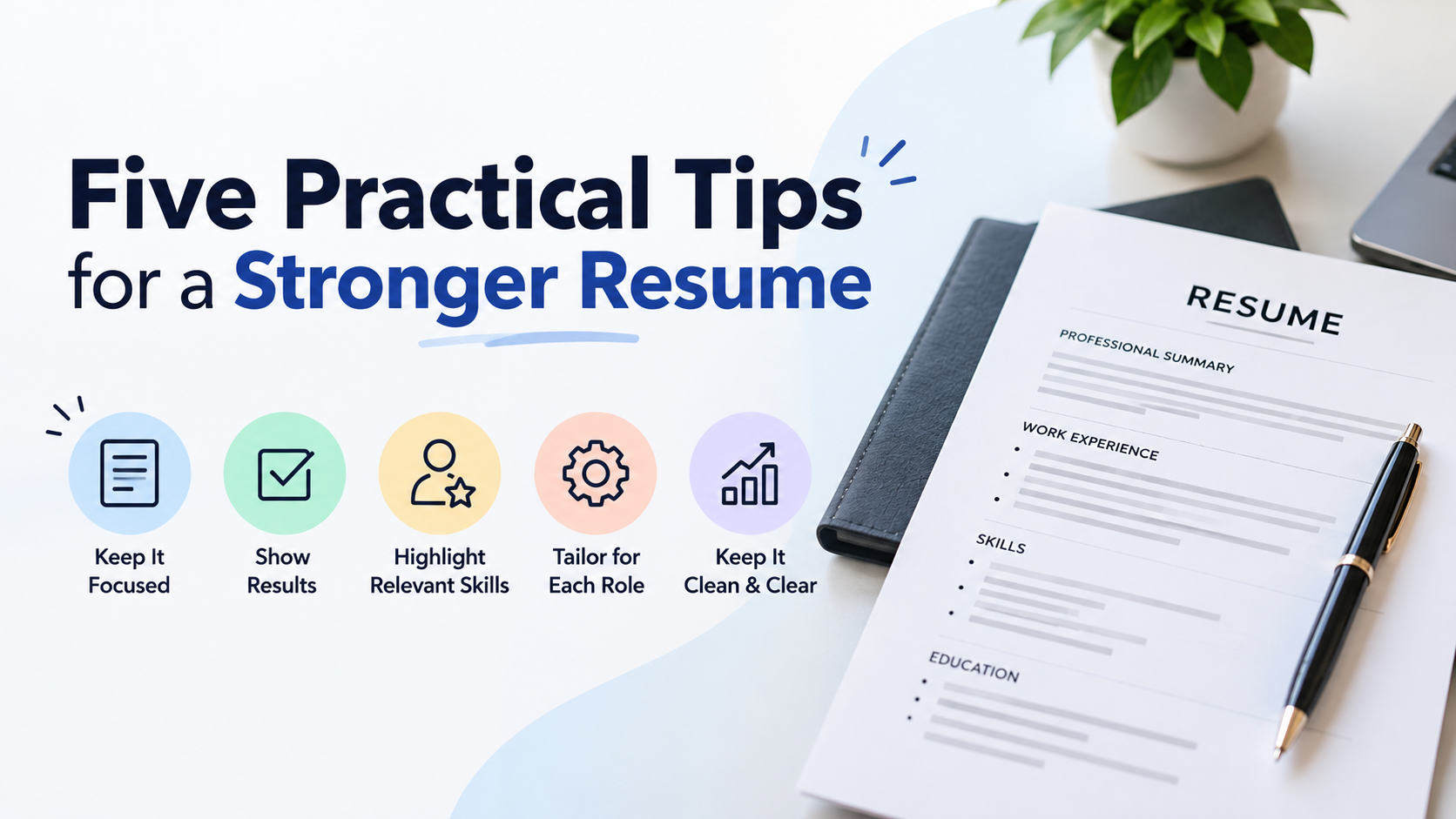
A stronger resume makes your value easy to understand by focusing on relevant experience, using specific evidence, organizing information clearly, and matching the language of the target role. These five practical tips can help you improve your resume without exaggerating your background or filling the page with unnecessary detail.
1. Tailor your relevant experience
A resume should not treat every past responsibility as equally important. Employers usually want to see how your experience connects to the position they are filling, so start by identifying the qualifications and responsibilities emphasized in the job description.
Review the posting for recurring themes such as customer service, project coordination, data analysis, inventory management, or software knowledge. Then bring your closest experience forward. This may include paid employment, internships, volunteer work, academic projects, freelance assignments, or relevant training.
How to tailor a resume
- Read the job description before editing your resume.
- Highlight requirements you can support with real experience.
- Move the most relevant skills and accomplishments higher on the page.
- Use the employer's terminology when it accurately describes your background.
- Remove or shorten details that do not help explain your fit.
For example, a general bullet such as “Handled customer questions” could become “Resolved customer questions by phone and email while documenting cases in the support system.” The revised version adds context, but it should only be used if it accurately reflects what you did.
2. Show accomplishments, not only duties
Responsibilities explain what a role involved. Accomplishments show how you contributed. Strong resume bullets often combine the action, the work performed, and the result or purpose.
Begin by replacing broad statements with precise verbs. Depending on your experience, useful verbs may include coordinated, prepared, improved, organized, supported, analyzed, trained, or resolved.
A simple accomplishment formula
Action + task or method + result, scope, or purpose
For example:
- Prepared weekly inventory reports to help the team identify products requiring replenishment.
- Coordinated appointment scheduling and maintained accurate records for a busy office.
- Created a project tracking spreadsheet that gave team members a clearer view of deadlines and open tasks.
Use numbers when you know they are accurate, such as the number of customers served, projects completed, reports prepared, or team members supported. If you do not have a verified metric, do not invent one. A clear qualitative result is better than an unsupported number.
3. Make the structure easy to scan
Resume design should support quick reading rather than compete with the content. Use a predictable structure so a reader can find your contact information, summary, experience, education, and skills without effort.
Recommended resume sections
- Contact information: Include your name, a professional email address, phone number, and relevant links if applicable.
- Summary: Give a brief overview of your experience, strengths, and target direction.
- Experience: List positions in reverse chronological order, with the most recent role first.
- Education: Include relevant degrees, programs, or training that you actually completed or are currently pursuing.
- Skills: List tools, technical abilities, languages, and other job-related capabilities you can support.
- Projects or certifications: Add these sections when they provide relevant evidence of your qualifications.
Use standard section headings, consistent date formatting, readable text, and enough white space to separate sections. Avoid placing essential information inside images, decorative graphics, or unusual layouts. Clear, selectable text is easier for people to read and more dependable when a resume is processed by an applicant tracking system, or ATS.
4. Strengthen your summary and skills section
Your summary is often the first content a reader sees after your name. It should explain what you offer and what type of opportunity you are seeking, rather than relying on vague phrases such as “hard worker” or “team player” without supporting context.
A useful summary can mention your professional area, level of experience, strongest relevant capabilities, and target contribution. For example:
Administrative professional with experience supporting scheduling, records management, customer communication, and day-to-day office coordination. Known for organized follow-through and accurate documentation.
Use a skills section to make relevant capabilities easy to locate. Include skills that appear in the job description only when you genuinely have them. Grouping skills can improve clarity:
- Tools: Spreadsheet software, customer relationship management systems, scheduling platforms
- Operations: Recordkeeping, calendar coordination, order processing
- Communication: Customer support, written correspondence, presentation preparation
Do not use a skills list as a substitute for evidence. If a skill matters to the role, show where you used it in your experience, project, or education section whenever possible.
5. Proofread, verify, and customize before submitting
A resume can lose credibility through small errors, inconsistent dates, unclear wording, or claims that are difficult to verify. Review every section before sending it and confirm that the information is accurate.
Final resume review checklist
- Check spelling, grammar, punctuation, and capitalization.
- Confirm that job titles, employer names, dates, and locations are correct.
- Make sure verb tense is consistent: use past tense for completed work and present tense for current responsibilities.
- Check that formatting remains readable when the file is opened or converted to PDF.
- Remove duplicated bullets and repeated phrases.
- Confirm that every listed skill is truthful and relevant.
- Save the final version with a clear filename, such as
FirstName_LastName_Resume.pdf.
It can also help to read the resume aloud or ask someone to identify the strongest qualification they notice in the first few seconds. If that qualification is not clear, revise the summary or move the most relevant evidence higher.
Frequently asked questions about building a stronger resume
How long should a resume be?
The appropriate length depends on your experience and the role. Use enough space to present relevant evidence clearly, but remove repetition and unrelated details. A concise resume is usually more effective than one that includes every task from every job.
Should every resume be customized for the job?
Yes, each application should receive at least a focused review. Adjust the summary, skills, and experience bullets so they emphasize qualifications relevant to that specific position. Keep all changes truthful.
What makes a resume ATS-friendly?
An ATS-friendly resume uses standard headings, clear text, a predictable reading order, and relevant keywords supported by real experience. Avoid relying on images, icons, hidden text, or complicated layouts for essential information.
What should I do if I lack direct experience?
Highlight transferable skills and related evidence from projects, education, volunteering, internships, freelance work, or other responsibilities. Explain the connection clearly instead of claiming experience you do not have.
Take the next step
Choose one target job and compare its requirements with your current resume. Mark the three most relevant qualifications, revise one summary statement, and rewrite at least two experience bullets to show clearer actions and outcomes. Then proofread the complete document and confirm that every claim is accurate before submitting it.