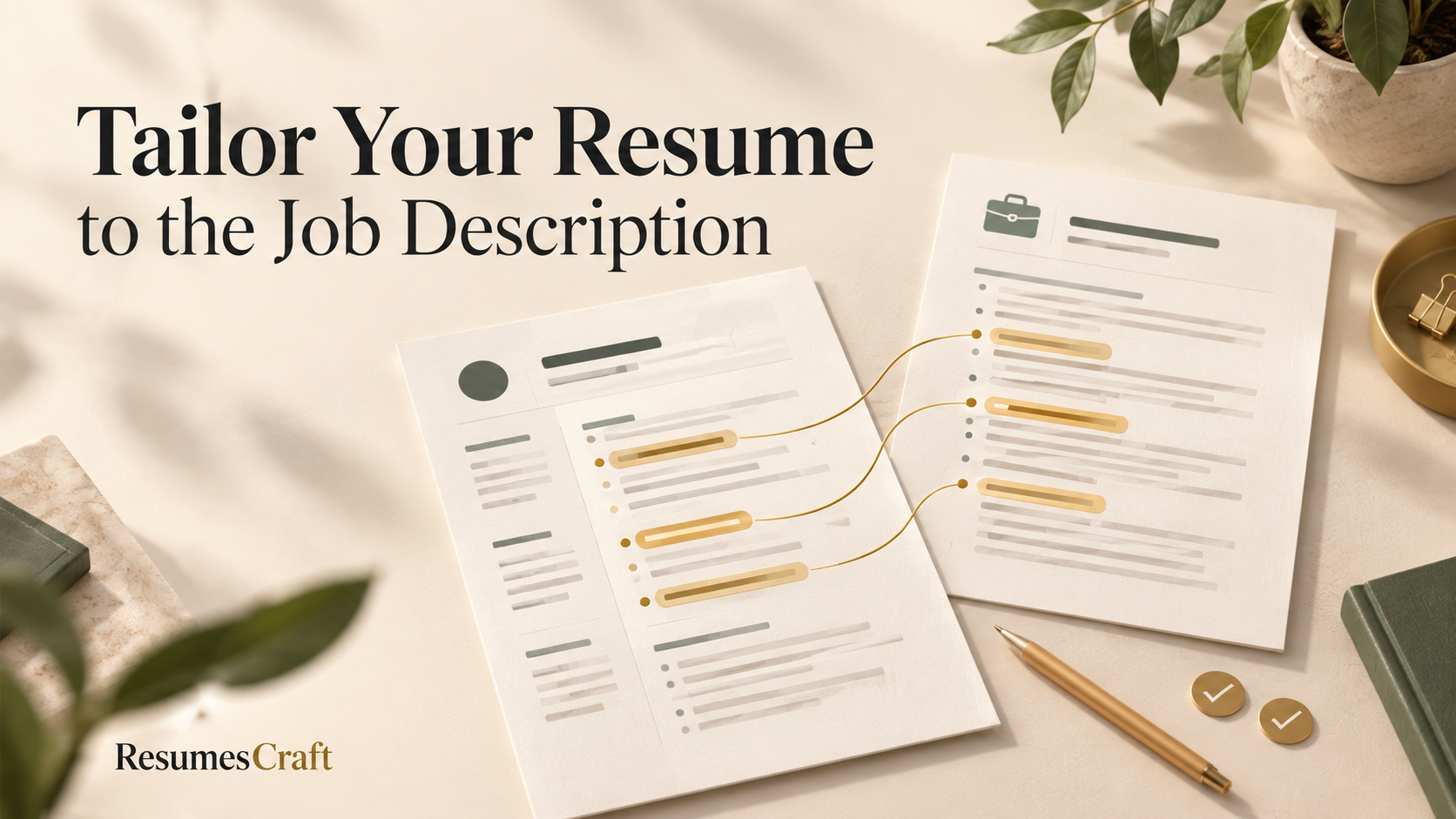
You find a job that fits your background, attach your usual resume, and press apply. But does that resume make the connection clear? A recruiter should be able to find the experience that matters for this particular role without having to piece it together.
Tailoring your resume means choosing and explaining your real experience around the employer’s needs. Your work history stays accurate. What changes is the emphasis: which skills appear first, which achievements get space, and how clearly you explain their relevance.
Harvard’s career guidance recommends shaping your resume around the skills an employer values. Start with that principle, then use the workflow below to turn a general resume into a focused application.
1. Read the job description for priorities
Before editing a sentence, identify what the employer needs someone to do. Separate essential qualifications from preferred skills, then look at the responsibilities. A long list of tools can distract you from the actual job.
Write down three to five priorities. These might include resolving customer requests, building reports, managing a project, improving a website, or coordinating a team. Next to each priority, note a real example from your experience.
If a requirement has no supporting evidence, leave it as a gap. You can explain a relevant transferable skill, but do not claim experience you do not have.
2. Match each priority to evidence
A useful planning method is a simple requirement-and-evidence table. The example below is fictional and shows how a customer support applicant might prepare.
| Job requirement | Evidence to include, if true |
|---|---|
| Handle customer inquiries | Answered email and chat requests in a retail support role. |
| Maintain accurate records | Updated customer notes and tracked unresolved requests. |
| Collaborate across teams | Coordinated with warehouse staff to resolve delivery issues. |
| Use a specific CRM | Name that CRM only if you used it; otherwise describe the system you actually know. |
This step gives you a reason for every edit. It also prevents you from adding keywords that look relevant but cannot be supported in an interview.
3. Make your opening summary specific
If you include a summary, use it to introduce the experience that fits the role. Replace broad descriptions such as “hardworking professional seeking a challenging opportunity” with a short account of what you can contribute.
Generic: Motivated professional with excellent communication skills and a passion for success.
Targeted, fictional example: Customer support professional experienced in email and chat service, order tracking, and complaint resolution. Coordinates with fulfillment teams to help customers understand delivery updates and next steps.
Use only statements you can explain with examples. A student can introduce relevant projects or internships. A career changer can focus on transferable work, such as reporting, troubleshooting, training, or client communication.
4. Put relevant achievements first
Keep your jobs and dates accurate, and arrange roles in a consistent order. Within each role, move the most relevant bullet points toward the top. A reporting-heavy job should make your reporting work easy to find. A service role should surface your customer-facing experience.
Build stronger bullets with this structure: action + work performed + result or scope. Numbers are useful when you can verify them. A clear description of scope is better than an invented percentage.
Before: Responsible for reports.
After, fictional example: Built weekly Excel sales reports for three store managers, highlighting stock shortages and product trends for replenishment planning.
Before: Worked on websites.
After, fictional example: Built responsive WordPress landing pages and resolved mobile layout issues, checking forms and navigation before client handover.
These examples describe what happened and why the work mattered. Adapt the approach to your experience; do not copy the details as your own.
5. Use relevant keywords naturally
Look for named tools, technical skills, certifications, and industry terms in the posting. When they accurately describe your background, use that wording in your skills section or experience bullets.
For example, if you have used Microsoft Excel, name it rather than writing only “office software.” If you have built WordPress websites, write “WordPress” and explain the work. Specific terms help readers understand your experience.
Avoid repeating the whole job description, hiding text, or listing skills you have never used. There is no universal keyword count or ATS score that guarantees an interview. Treat compatibility feedback as a way to review your document, and keep the final wording clear for a person reading it.
6. Keep the application easy to review
Use recognizable headings such as Experience, Education, Skills, and Projects. Keep dates, spacing, and bullet styles consistent. Give important details room to breathe, and remove information that adds little to this application.
Follow the employer’s file instructions. If a particular format is requested, use it. Open the exported document before sending it and check for cut-off text, unexpected page breaks, and broken links. If the application portal extracts your details, review those fields too.
For more formatting guidance, read 10 Tips for Creating an ATS-Friendly Resume.
7. Use AI to improve wording, then check every claim
AI can help you compare a draft with a job description, identify unclear sentences, or suggest sharper bullet points. Give it your actual experience and set limits before accepting a rewrite.
Example prompt: “Review my resume against this job description. Suggest clearer wording for experience that is already supported by my resume. Do not add tools, qualifications, employers, dates, metrics, or responsibilities. List missing requirements separately.”
Read every suggestion carefully. Check that the wording reflects your level of responsibility and that you could discuss it comfortably in an interview. Do not include confidential customer details or internal business information in a writing prompt.
A final checklist before you apply
- The opening section makes my relevant experience easy to understand.
- The employer’s main priorities have supporting examples where my background matches.
- My most relevant bullets appear early within each role.
- Every tool, qualification, date, and number is accurate.
- My resume and cover letter tell a consistent story.
- I followed the required file format and checked the exported document.
- My contact details and portfolio links work.
- I saved a copy of this version with the job description.
Frequently asked questions
Do I need to rewrite my entire resume for every job?
Usually, you can keep the main structure and update the summary, skills emphasis, and selected bullets. Keep a master document containing your full experience so you can choose the most relevant material for each application.
What if I do not meet every requirement?
Read the posting carefully to distinguish essential requirements from preferences. Present the qualifications you do have and explain relevant transferable experience. Do not disguise a missing license, qualification, or technical skill.
Can a tailored resume guarantee an interview?
No. Tailoring helps communicate fit, but an employer’s decision also depends on the role’s requirements, the applicant pool, and the rest of the hiring process.
Create a resume for your next application
Use ResumesCraft’s resume builder to organize your experience, refine your wording with AI assistance, and preview your resume. Start building for free, then review the current plans for downloads and expanded features.
Begin with one job description and one accurate draft. Make the connection between your experience and the role clear, then check the final version before applying.
Further reading
- Harvard Mignone Center for Career Success: Creating a Strong Resume — guidance on presenting relevant skills and experience.
- CareerOneStop: Target Your Resume — advice on keeping a master resume and selecting material for individual roles.